Showing posts with label UNIVERSE. Show all posts

Sunday, March 11, 2012

DWARF PLANETS

DWARF PLANETS

From : http://lasp.colorado.edu/education/outerplanets/kbos_dwarfplanets.php
From : http://www.librarising.com/space/ceres.html

Difference Planet and Dwarf Planet


Planet define as celestial body that:
  • Is in orbit around a star, but is not itself a satellite*
  • Has sufficient mass so it is nearly spherical in shape*
  • Has cleared the neighborhood around its orbit*
Dwarf Planet define as celetial body that:
  • Is in orbit around a star, but is not itself a satellite*
  • Has sufficient mass so it is nearly spherical in shape*
  • Has not cleared the neighborhood around its orbit*
Dwarf Planets


http://www.zanestein.com/sizes.jpg


Orbit Dwarf Planets

http://www.lunarplanner.com/Images/asteroid-orbits/dwarf-orbits-side.gif

 
Dwarf Planet


Pluto

For 76 years (until 2006), Pluto was known as the ninth planet in our solar system. Since then, Pluto has been relegated to dwarf planet status. Discovered in 1930, Pluto is a member of the outer region of our solar system known as the Kuiper belt. It has a highly inclined and eccentric 248-year orbit around the Sun. As the second-largest known dwarf planet, Pluto is approximately 2,390 km in diameter and is composed primarily of ice and rock. It is very difficult to precisely determine the diameter of Pluto since it is so far away. Pluto is, on average, 40 times farther from the Sun than Earth.

Pluto and Charon

Pluto's Moons

In 1978, the discovery of Pluto's largest moon, Charon, gave scientists an opportunity to learn more about Pluto. The two icy objects eclipsed each other from Earth's point of view from 1985-1990 allowing scientists to more precisely determine their diameters and masses. At approximately 1,186 km, Charon's diameter is just less than half of Pluto's. Pluto is also eight times more massive than Charon.

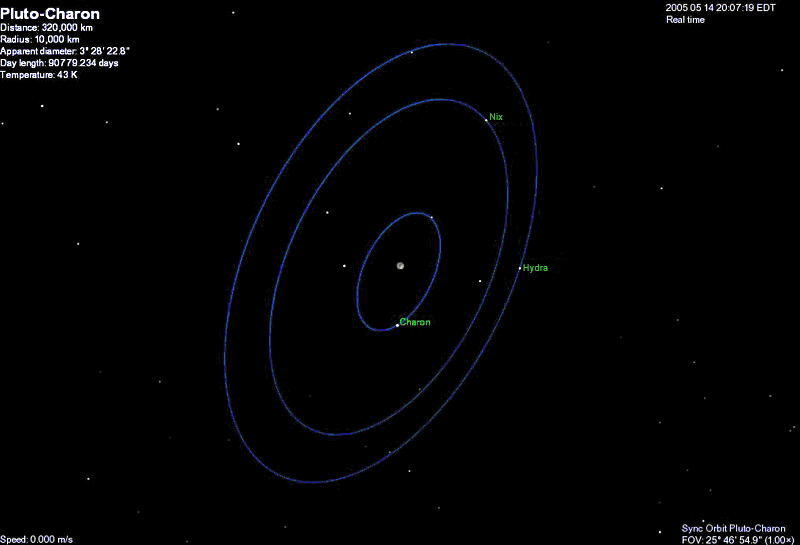
Pluto and its three known satellites Charon, Nix and Hydra.

Two more moons were discovered orbiting Pluto in 2005. Nix and Hydra are considerably smaller than Pluto and Charon, at only 40 km and 160 km in diameter, respectively. Nix orbits Pluto at 48,700 km from the center of mass of the system, more than twice the orbital distance of Charon. Hydra is the outermost of Pluto's satellites, orbiting at 64,800 km from the center of mass of the Plutonian system.

Charon, Nix and Hydra Orbit

http://www.universetoday.com/wp-content/uploads/2008/02/nixhydraorbit_lg.jpg

Ceres

Italian astronomer Giuseppe Piazzi discovered Ceres in 1801. First classified as a planet, Ceres was later catalogued as an asteroid. With the discovery of Eris in 2005, after 150 years as the head of the asteroid belt, Ceres became the solar system's smallest dwarf planet. Ceres is still the largest, and by far the most massive member of the asteroid belt. The diameter of Ceres is about 950 km and it alone makes up one third of the asteroid belt's total mass.

http://www.lpl.arizona.edu/undergrad/classes/spring2011/Hubbard_206/Lectures4/070620_hubble_ceres_02.jpg

Ceres Orbit

http://www.librarising.com/space/images/ceresorbit.jpg

Ceres Size Compared To Our Moon


Eris

Discovered in 2005, Eris is now the largest known dwarf planet in our solar system. Its diameter is estimated at 3000 km, and it weighs roughly 1.66 x 10²² kg, which is about 27% more massive than Pluto. Like Pluto, it is very difficult to make precise measurements of Eris' diameter and mass, but these are the most updated estimates.

http://www.gps.caltech.edu/~mbrown/planetlila/hubble.jpeg
Hubble Image

Eris orbits the Sun at the far reaches of our solar system in an area known as the scattered disk. Scattered disk objects (SDOs) tend to have highly inclined and eccentric orbits. Eris' orbit is tilted at an angle of 44 degrees with respect to the ecliptic. You can see from the picture how much more inclined this is compared to Pluto's orbit, which is tilted only 17 degrees to the ecliptic. Eris' orbital period is just over 556 years. Currently, at a distance of about 97 AU, Eris is at aphelion. It won't be closest to the Sun, at perihelion, until March 2257.

http://upload.wikimedia.org/wikipedia/commons/thumb/d/dc/Eris_Orbit.svg/644px-Eris_Orbit.svg.png


Sedna
From : http://www.cosmosportal.org/topics/view/11910/
From : http://www.daviddarling.info/encyclopedia/S/Sedna.html

http://science.nasa.gov/media/medialibrary/2004/03/15/16mar_sedna_resources/discovery.gif

The most distant large object yet found orbiting the Sun and a candidate, but not an official, dwarf planet. It is currently 88 AU from the Sun, about three times farther than Neptune. Its classification remains uncertain – some researchers claim it is a detached Kuiper Belt object, while others suspect it might belong to the Oort Cloud. Sedna, named after the Inuit goddess of the ocean, is currently three times further away than Pluto, the average distance of which from the Sun is 5.9 billion km (3.6 billion miles). At its most distant, Sedna is almost 150 billion km (93 billion miles) from the Sun, or 990 times Earth's solar distance. It has an obital period, or year, of some 10,500 years. Its surface temperature is believed to be about -240°C (-400°F).

Sedna, originally designated 2003 VB12, was first seen on Nov. 14, 2003 with the 48-inch Samuel Oschin Telescope at California's Mount Palomar Observatory. Astronomers from the California Institute of Technology, Yale University, and the Gemini Observatory were involved in the discovery. Observations show it measures less than 1,700 km (about 1,000 miles) in diameter, which is smaller than Pluto. Sedna has a high albedo and very red – the reddest large object in the Solar System after Mars. Its size suggests it should not be classified as a true planet, although there is disagreement among astronomers on this point and there are no hard and fast rules about what counts as a planet, planetoid, or minor planet. Sedna rotates more slowly on its axis than expected, suggesting it may have a satellite orbiting it.


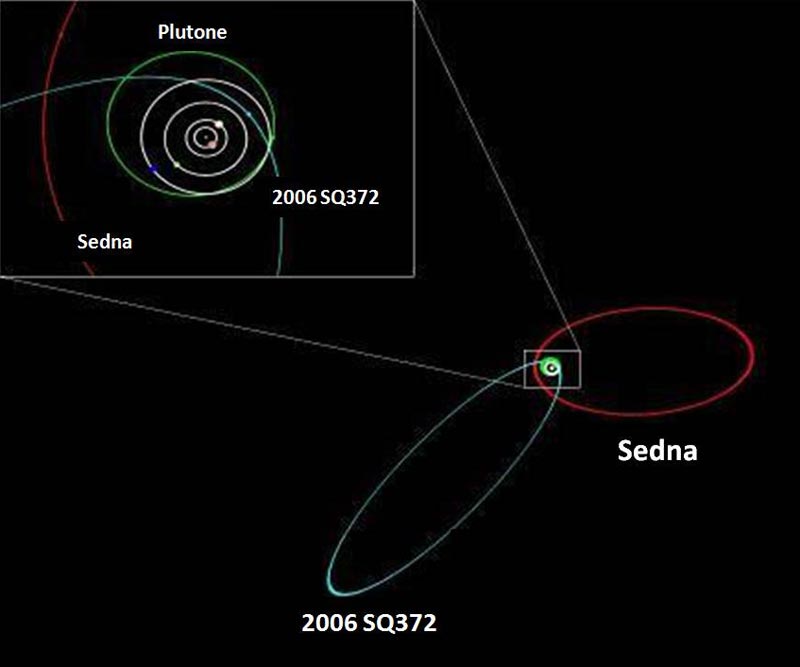
Sedna Orbit

http://www.astronomia.com/wp-content/uploads/2008/08/2006-sq372-big.jpg


SUPER MASSIVE BLACK HOLES

SUPER MASSIVE BLACK HOLES (death star galaxy)

Article from
-http://www.spacescan.org/entry/astronomers-observe-black-hole-gobbling-up-galaxy/
-http://www.nasa.gov/mission_pages/chandra/multimedia/photos07-139.html

Black holes have baffled scientists for a long time. The dense mass of the dead star that has is dense enough to gobble huge planets and stars. Recently astronomers have discovered a powerful black hole blasting a galaxy.

Astronomers have earlier witnessed collision between galaxies but this is the first time they have seen collision of such large scale. In a recent discovery a large galaxy called the ‘death star galaxy‘ has a jet of high energy particles and magnetic fields emanating from the back hole at its centre that is gobbling a smaller galaxy standing close to it. Black holes are present at the centre of most galaxies. Some galaxies eject powerful jets from the vicinity of the black holes.

A jet from a black hole at the center of a galaxy strikes the edge of another galaxy.
Image credit: X-ray: NASA/CXC/CfA/D.Evans et al.; Optical/UV: NASA/STScI; Radio: NSF/VLA/CfA/D.Evans et al., STFC/JBO/MERLIN

This composite image shows the jet from a black hole at the center of a galaxy striking the edge of another galaxy, the first time such an interaction has been found. In the image, data from several wavelengths have been combined. X-rays from Chandra (colored purple), optical and ultraviolet (UV) data from Hubble (red and orange), and radio emission from the Very Large Array (VLA) and MERLIN (blue) show how the jet from the main galaxy on the lower left is striking its companion galaxy to the upper right. The jet impacts the companion galaxy at its edge and is then disrupted and deflected, much like how a stream of water from a hose will splay out after hitting a wall at an angle.


A Black hole is a hypothetical region of space possessing a gravitational field so intense that no matter or radiation can escape from it. Such regions are said to form when a star collapses, having used all its nuclear fuel. Smaller stars create supernova explosions when they die leaving neutron star; it is the more massive stars that are believed to create black holes.

Though the current discovery shows the black hole feeding on the smaller galaxy causing its death, the strangest fact of such cosmic event is that eventually after the destruction is complete the massive influx of energy and radiation into the smaller galaxy will create new stars and planet - a Sphinx-like rise from the ashes of death.

The problem of detecting black holes is that they are unable to emit or reflect any radiation.

Earth is safe from the havoc causing actions of black holes. If our solar system came in the line of fire of any jet emanating black hole then the ozone layer of the earth’s atmosphere would be destroyed and life on the planet would face mass extinction.

How safe is our planet from the scourges of the black holes. Astronomers believe there are two such beasts near the centre of our galaxy, the Milky Way.

BLACK HOLE

BLACK HOLE

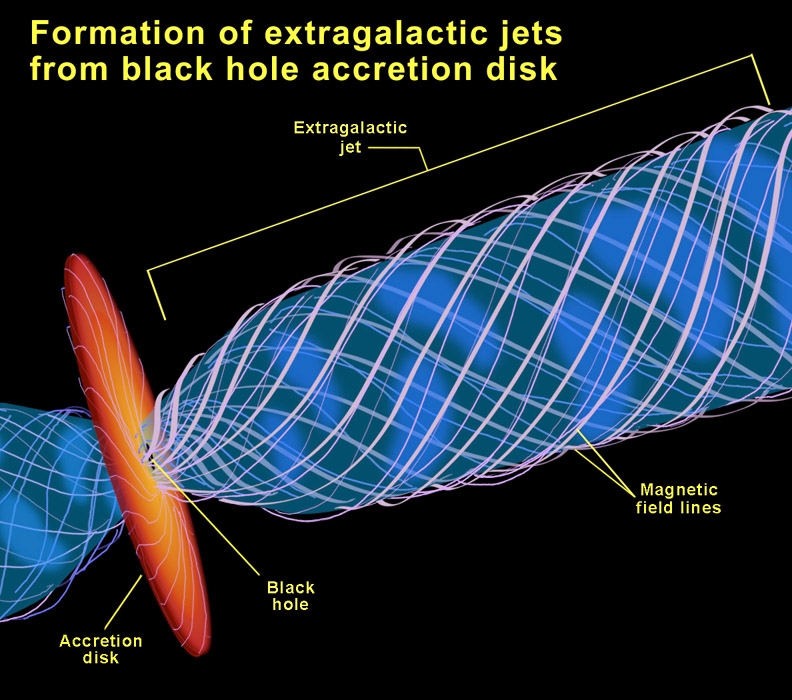
A black hole, according to the general theory of relativity, is a region of space from which nothing, including light, can escape. It is the result of the deformation of spacetime caused by a very compact mass. Around a black hole there is an undetectable surface which marks the point of no return, called an event horizon. It is called "black" because it absorbs all the light that hits it, reflecting nothing, just like a perfect black body in thermodynamics. nder the theory of quantum mechanics black holes possess a temperature and emit Hawking radiation.

http://upload.wikimedia.org/wikipedia/commons/a/ab/Black_hole_jet_diagram.jpg

Despite its invisible interior, a black hole can be observed through its interaction with other matter. A black hole can be inferred by tracking the movement of a group of stars that orbit a region in space. Alternatively, when gas falls into a stellar black hole from a companion star, the gas spirals inward, heating to very high temperatures and emitting large amounts of radiation that can be detected from earthbound and Earth-orbiting telescopes.


Black holes are the evolutionary endpoints of stars at least 10 to 15 times as massive as the Sun. If a star that massive or larger undergoes a supernova explosion, it may leave behind a fairly massive burned out stellar remnant. With no outward forces to oppose gravitational forces, the remnant will collapse in on itself. The star eventually collapses to the point of zero volume and infinite density, creating what is known as a " singularity ". Around the singularity is a region where the force of gravity is so strong that not even light can escape. Thus, no information can reach us from this region. It is therefore called a black hole, and its surface is called the " event horizon ".

ASTEROID

ASTEROID

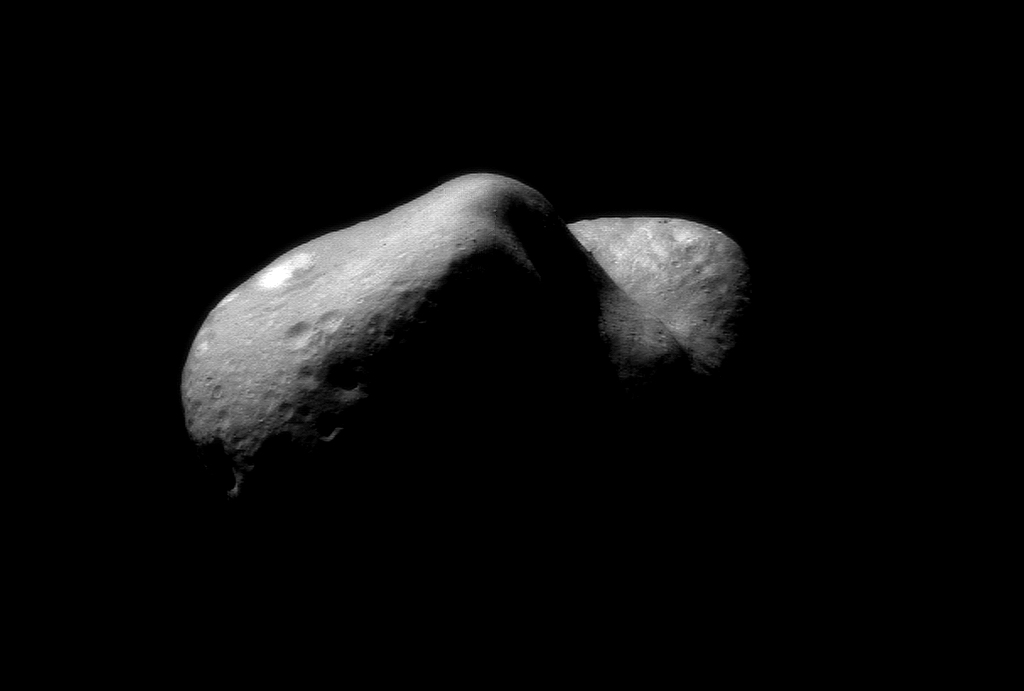
File:433eros.jpg

Asteroids, sometimes called minor planets or planetoids, are small Solar System bodies in orbit around the Sun, especially in the inner Solar System; they are smaller than planets but larger than meteoroids. The term "asteroid" has historically been applied primarily to minor planets of the inner Solar System, as the outer Solar System was poorly known when it came into common usage. The distinction between asteroids and comets is made on visual appearance: Comets show a perceptible coma while asteroids do not.

Traditionally, small bodies orbiting the Sun were classified as asteroids, comets or meteoroids, with anything smaller than ten metres across being called a meteoroid. The term "asteroid" is ill-defined. It never had a formal definition, with the broader term minor planet being preferred by the International Astronomical Union until 2006, when the term "small Solar System body" (SSSB) was introduced to cover both minor planets and comets. The 2006 definition of SSSB says that they "include most of the Solar System asteroids, most trans-Neptunian objects (TNOs), comets, and other small bodies".

It is believed that planetesimals in the main asteroid belt evolved much like the rest of the Solar Nebula until Jupiter neared its current mass, at which point excitation from orbital resonances with Jupiter ejected over 99% of planetesimals in the belt. Simulations and a discontinuity in spin rate and spectral properties suggest that asteroids larger than approximately 120 km (75 mi) in diameter accreted during that early era, whereas smaller bodies are fragments from collisions between asteroids during or after the Jovian disruption. At least two asteroids, Ceres and Vesta, grew large enough to melt and differentiate, with heavy metallic elements sinking to the core, leaving rocky minerals in the crust.

In the Nice model, many Kuiper Belt objects are captured in the outer Main Belt, at distances greater than 2.6 AU. Most were later ejected by Jupiter, but those that remained may be the D-type asteroids, and possibly include Ceres.

http://upload.wikimedia.org/wikipedia/commons/0/0f/Lhborbits.png

Asteroids contain traces of amino-acids and other organic compounds, and some speculate that asteroid impacts may have seeded the early Earth with the chemicals necessary to initiate life, or may have even brought life itself to Earth.

File:Masses of asteroids compared.png

Only one asteroid, 4 Vesta, which has a reflective surface, is normally visible to the naked eye, and this only in very dark skies when it is favorably positioned.

http://upload.wikimedia.org/wikipedia/commons/f/f3/InnerSolarSystem-en.png

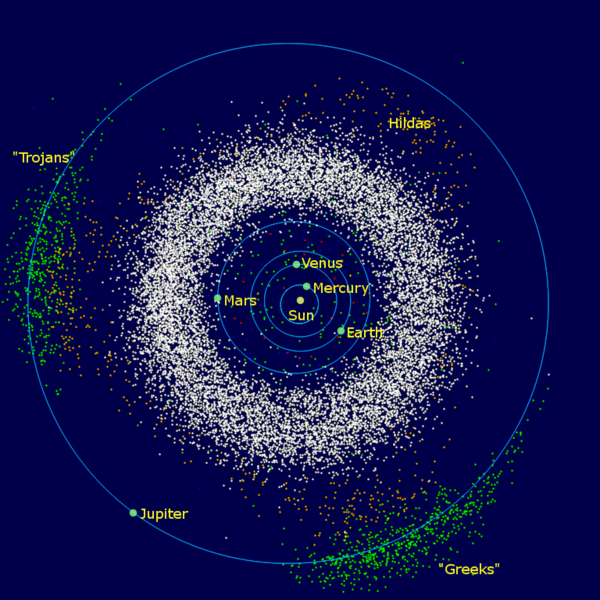
The majority of known asteroids orbit within the main asteroid belt between the orbits of Mars and Jupiter, generally in relatively low-eccentricity (i.e., not very elongated) orbits. This belt is now estimated to contain between 1.1 and 1.9 million asteroids larger than 1 km (0.6 mi) in diameter, and millions of smaller ones. These asteroids may be remnants of the protoplanetary disk, and in this region the accretion of planetesimals into planets during the formative period of the solar system was prevented by large gravitational perturbations by Jupiter. Although fewer Trojan asteroids sharing Jupiter's orbit are known, it is thought that there are as many as there are asteroids in the main belt.

The dwarf planet Ceres is the largest object in the asteroid belt, with a diameter of over 975 km (606 mi). The next largest are the asteroids 2 Pallas and 4 Vesta, both with diameters of over 500 km (311 mi). Normally Vesta is the only main belt asteroid that can, on occasion, become visible to the naked eye. However, on some rare occasions, a near-Earth asteroid may briefly become visible without technical aid; see 99942 Apophis.

The mass of all the objects of the Main asteroid belt, lying between the orbits of Mars and Jupiter, is estimated to be about 3.0-3.6 × 10²¹ kg, or about 4 percent of the mass of the Moon. Of this, Ceres comprises 0.95 × 10²¹ kg, some 32 percent of the total. Adding in the next three most massive objects, Vesta (9%), Pallas (7%), and Hygiea (3%), brings this figure up to 51%; while the three after that, 511 Davida (1.2%), 704 Interamnia (1.0%), and 52 Europa (0.9%), only add another 3% to the total mass. The number of asteroids then increases rapidly as their individual masses decrease.

STAR

STAR

A star is a massive, luminous ball of plasma that is held together by gravity. The nearest star to Earth is the Sun, which is the source of most of the energy on Earth. Other stars are visible in the night sky, when they are not outshone by the Sun. Historically, the most prominent stars on the celestial sphere were grouped together into constellations, and the brightest stars gained proper names. Extensive catalogues of stars have been assembled by astronomers, which provide standardized star designations.

For most of its life, a star shines due to thermonuclear fusion in its core releasing energy that traverses the star's interior and then radiates into outer space. Almost all naturally occurring elements heavier than helium were created by stars, either via stellar nucleosynthesis during their lifetimes or by supernova nucleosynthesis when stars explode. Astronomers can determine the mass, age, chemical composition and many other properties of a star by observing its spectrum, luminosity and motion through space. The total mass of a star is the principal determinant in its evolution and eventual fate. Other characteristics of a star are determined by its evolutionary history, including diameter, rotation, movement and temperature. A plot of the temperature of many stars against their luminosities, known as a Hertzsprung-Russell diagram (H–R diagram), allows the age and evolutionary state of a star to be determined.


The Hertzsprung -Russell (H-R) Diagram is a graph that plots stars color (spectral type or surface temperature) vs. its luminosity (intrinsic brightness or absolute magnitude). On it, astronomers plot stars' color, temperature, luminosity, spectral type, and evolutionary stage.

A star begins as a collapsing cloud of material composed primarily of hydrogen, along with helium and trace amounts of heavier elements. Once the stellar core is sufficiently dense, some of the hydrogen is steadily converted into helium through the process of nuclear fusion. The remainder of the star's interior carries energy away from the core through a combination of radiative and convective processes. The star's internal pressure prevents it from collapsing further under its own gravity. Once the hydrogen fuel at the core is exhausted, those stars having at least 0.4 times the mass of the Sun expand to become a red giant, in some cases fusing heavier elements at the core or in shells around the core. The star then evolves into a degenerate form, recycling a portion of the matter into the interstellar environment, where it will form a new generation of stars with a higher proportion of heavy elements.

Orbit5.gifOrbit3.gifOrbit4.gifOrbit1.gif

Binary and multi-star systems consist of two or more stars that are gravitationally bound, and generally move around each other in stable orbits. When two such stars have a relatively close orbit, their gravitational interaction can have a significant impact on their evolution. Stars can form part of a much larger gravitationally bound structure, such as a cluster or a galaxy.


STELLAR CLASSIFICATION

Stellar classification is a classification of stars based on their spectral characteristics. The spectral class of a star is a designated class of a star describing the ionization of its chromosphere, what atomic excitations are most prominent in the light, giving an objective measure of the temperature in this chromosphere.

Most stars are currently classified using the letters O, B, A, F, G, K and M, where O stars are the hottest and the letter sequence indicates successively cooler stars up to the coolest M class. According to an informal tradition, O stars are "blue", B "blue-white", A stars "white", F stars "yellow-white", G stars "yellow", K stars "orange", and M stars "red", even though the actual star colors perceived by an observer may deviate from these colors depending on visual conditions and individual stars observed.


The Harvard classification system is a one-dimensional classification scheme. Stars vary in surface temperature from about 2 to 40 kK (2,000 to 40,000 kelvins). Physically, the classes indicate the temperature of the star's atmosphere and are normally listed from hottest to coldest, as is done in the following table

Class Temperature[8]
(kelvins)
Conventional color Mass[8]
(solar masses)
Radius[8]
(solar radii)
Luminosity[8]
(bolometric)
Fraction of all
main sequence stars[12]
O ≥ 33,000 K blue ≥ 16 M☉ ≥ 6.6 R☉ ≥ 30,000 L☉ ~0.00003%
B 10,000–30,000 K blue to blue white 2.1–16 M☉ 1.8–6.6 R☉ 25–30,000 L☉ 0.13%
A 7,500–10,000 K white 1.4–2.1 M☉ 1.4–1.8 R☉ 5–25 L☉ 0.6%
F 6,000–7,500 K yellowish white 1.04–1.4 M☉ 1.15–1.4 R☉ 1.5–5 L☉ 3%
G 5,200–6,000 K yellow 0.8–1.04 M☉ 0.96–1.15 R☉ 0.6–1.5 L☉ 7.6%
K 3,700–5,200 K orange 0.45–0.8 M☉ 0.7–0.96 R☉ 0.08–0.6 L☉ 12.1%
M ≤ 3,700 K red ≤ 0.45 M☉ ≤ 0.7 R☉ ≤ 0.08 L☉ 76.45%

LIFE CYCLE OF THE SUN AND SOLAR SYSTEM

Projected timeline of the Sun's life.

The time frame of the Solar System's formation has been determined using radiometric dating. Scientists estimate that the Solar System is 4.6 billion years old. The oldest known mineral grains on Earth are approximately 4.4 billion years old. Rocks this old are rare, as Earth's surface is constantly being reshaped by erosion, volcanism, and plate tectonics. To estimate the age of the Solar System, scientists use meteorites, which were formed during the early condensation of the solar nebula. Almost all meteorites (see the Canyon Diablo meteorite) are found to have an age of 4.6 billion years, suggesting that the Solar System must be at least this old. Studies of discs around other stars have also done much to establish a time frame for Solar System formation. Stars between one and three million years old possess discs rich in gas, whereas discs around stars more than 10 million years old have little to no gas, suggesting that gas giant planets within them have ceased forming.

PLANETARY SYSTEM

A planetary system consists of the various non-stellar objects orbiting a star such as planets, dwarf planets, moons, asteroids, meteoroids, comets, and cosmic dust. The Sun together with its planetary system, which includes Earth, is known as the Solar System.

File:Artist Concept Planetary System.jpg

Planetary systems are generally believed to form as part of the same process which results in star formation. Some early theories involved another star passing extremely close to the Sun, drawing material out from it which then coalesced to form the planets.

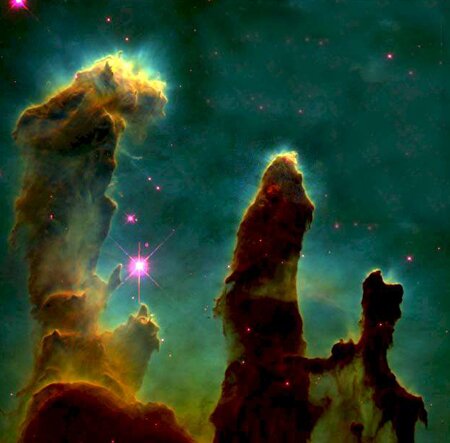
BIRTH OF STAR - THE EAGLE NEBULA


http://thearchnemesis.com/images/eagle%20nebula%20pillars%20creation.jpg

This part of the Eagle Nebula once looked like any other wispy cloudy nebula. But at some point in the past, new massive hot stars located above the frame of the photo started blazing away. They now send out intense ultraviolet radiation that sweeps away the gas and dust that makes up the nebula. It also heats up parts of the nebula enough to make them glow.

Why did the pillars form? The head of each pillar contains exceptionally dense clots of gas and dust that represent baby stars in the process of formation. Their strong gravitational fields pull in the surrounding gas and dust and thus hold this material in place against the stellar winds. The parts of the nebula 'downwind' of the clusters of baby stars are shielded from the wind and thus form pillars.

The baby stars need to reach a certain size before their centers attain the high temperatures and pressures needed to start up the nuclear fusion reactions that make a star a star. The baby stars in the heads of these columns are in a race against time: they have to suck in enough material to reach the right size before the rest of the surrounding gasses are blasted away. If they don't grow large enough, they won't become a proper star.

The longest pillar is 1 light-year long (about 5.88 trillion miles, or about 800 times longer than the diameter of our Solar System). The clouds consist mostly of hydrogen with traces of other gasses and dust. The microscopic dust particles include graphite and certain rocks and minerals found on Earth.

CLOSE-UP OF THE EAGLE NEBULA


http://listverse.files.wordpress.com/2009/12/hubble_j-tm.jpg?w=350&h=268

The tip of this column shows a number of 'fingers' pointing to the upper right. Each finger hosts in its tip a baby star. Some of these protostars may never ignite because they will be too small by the time the stellar winds strip away the raw materials needed for growth. You can see a tiny, faint, cocoon-shaped mass just to the upper-left of the pillar; this is a baby that has been cut off, apparently before it could ignite its nuclear furnace. In the upper right is a finger that is almost detached from the main pillar.

STAR FORMATION

Star formation is the process by which dense parts of molecular clouds collapse into a ball of plasma to form a star. As a branch of astronomy star formation includes the study of the interstellar medium and giant molecular clouds (GMC) as precursors to the star formation process and the study of young stellar objects and planet formation as its immediate products. Star formation theory, as well as accounting for the formation of a single star, must also account for the statistics of binary stars and the initial mass function.


Planetary systems are generally believed to form as part of the same process which results in star formation. Some early theories involved another star passing extremely close to the Sun, drawing material out from it which then coalesced to form the planets. However, the probability of such a near collision is now known to be far too low to make this a viable model. Accepted theories today argue that a protoplanetary disk forms by gravitational collapse of a molecular cloud and then evolves into a planetary system by collisions and gravitational capture.

Some planetary systems may form differently, however. Planets orbiting pulsars—stars which emit periodic bursts of electromagnetic radiation—have been discovered by the slight variations they cause in the timing of these bursts. Pulsars are formed in violent supernova explosions, and a normal planetary system could not possibly survive such a blast—planets would either evaporate, be pushed off of their orbits by the masses of gas from the exploding star, or the sudden loss of most of the mass of the central star would see them escape the gravitational hold of the star. One theory is that existing stellar companions were almost entirely evaporated by the supernova blast, leaving behind planet-sized bodies. Alternatively, planets may somehow form in the accretion disk surrounding pulsars.

SUPERNOVA INDUCED STAR FORMATION


The very massive stars form first and explode into supernova. This makes shock waves into the molecular cloud, causing nearby gas to compress and form more stars. This allows a type of stellar coherence (young stars are found near other young stars) to build up, and is responsible for the pinwheel patterns we see in galaxies.

LOW MASS AND HIGH MASS STAR

Difference between low-mass star and high-mass star.

http://www.abc.net.au/reslib/201007/r605660_3969428.jpg

Stars of different masses are thought to form by slightly different mechanisms. The theory of low-mass star formation, which is well-supported by a plethora of observations, suggests that low-mass stars form by the gravitational collapse of rotating density enhancements within molecular clouds. As described above, the collapse of a rotating cloud of gas and dust leads to the formation of an accretion disk through which matter is channeled onto a central protostar. For stars with masses higher than about 8 solar masses, however, the mechanism of star formation is not well understood.

Massive stars emit copious quantities of radiation which pushes against infalling material. In the past, it was thought that this radiation pressure might be substantial enough to halt accretion onto the massive protostar and prevent the formation of stars with masses more than a few tens of solar masses. Recent theoretical work has shown that the production of a jet and outflow clears a cavity through which much of the radiation from a massive protostar can escape without hindering accretion through the disk and onto the protostar. Present thinking is that massive stars may therefore be able to form by a mechanism similar to that by which low mass stars form.

SOLAR SYSTEM PLANETS

SOLAR SYSTEM PLANETS

MERCURY
mercury
Mercury is the closest planet to the Sun and the eighth largest. Mercury is slightly smaller in diameter than the moons Ganymede and Titan but more than twice as massive.

Orbit from Sun: 57,910,000 km (0.38 AU)
Orbital period: 87.969 days (0.240846 yr)
Average orbital speed: 47.87 km/s
Diameter: 4,880 km
Mass: 3.30e23 kg
Equatorial surface gravity: 3.7 m/s² 0.38 g
Surface temp min 80 K, max 700 K
Sidereal rotation period: 58.646 day (1407.5 h)
Equatorial rotation velocity: 10.892 km/h (3.026 m/s)
Mercury has no satellites.

VENUS
venus
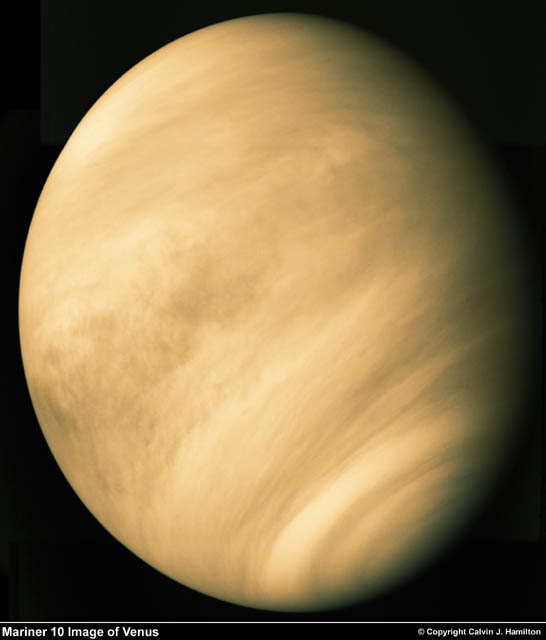
Venus is the second planet from the Sun and the sixth largest. Venus' orbit is the most nearly circular of that of any planet, with an eccentricity of less than 1%.

Orbit from Sun: 108,200,000 km (0.72 AU)
Orbital period: 224.70069 days (0.6151970 yr)
Average orbital speed: 35.02 km/s
Diameter: 12,103.6 km
Mass: 4.869e24 kg
Equatorial surface gravity: 8.87 m/s² 0.904 g
Surface temp: mean 735 K (461.85 °C)
Sidereal rotation period: 243.0185 day
Equatorial rotation velocity: 6.52 km/h (1.81 m/s)
Venus has no satellites.
Venus is sometimes regarded as Earth's sister planet. In some ways they are very similar:
• Venus is only slightly smaller than Earth (95% of Earth's diameter, 80% of Earth's mass).
• Both have few craters indicating relatively young surfaces.
• Their densities and chemical compositions are similar.

EARTH
earth
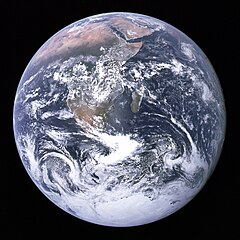
Earth is the third planet from the Sun and the fifth largest

Orbit from Sun: 149,600,000 km (1.00 AU)
Orbital period: 365.256366 days (1.0000175 yr)
Average orbital speed: 29.783 km/s (107218 km/h)
Diameter: 12,756.3 km
Mass: 5.972e24 kg
Equatorial surface gravity: 9.81 m/s² 0.997 g
Surface temp: mean 287 K (14 °C)
Sidereal rotation period: 0.99726968 day
Equatorial rotation velocity: 1674.4 km/h (465.1 m/s)
Earth has only one natural satellite, the Moon.
moon

Moon (radius: 1738 km, mass: 7.35e22 kg, orbit from earth: 384000 km)
scalemoon

A scale representation of the relative sizes of, and distance between, Earth and Moon.
Distance  Radius    Mass
Satellite  (000 km)   (km)     (kg)
---------  --------  ------  -------
Moon        384       1738   7.35e22

MARS
mars
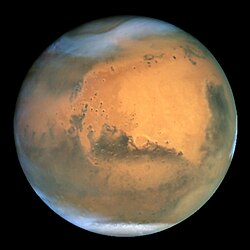
Mars is the fourth planet from the Sun and the seventh largest

Orbit from Sun: 227,940,000 km (1.52 AU)
Orbital period: 686.971 days (1.8808 yr)
Average orbital speed: 24.077 km/s
Diameter: 6,794 km
Mass: 6.4219e23 kg
Equatorial surface gravity: 3.68 m/s² 0.375 g
Surface temp: mean 227 K (-46 °C)
Sidereal rotation period: 1.025957 day (24.62296 h)
Equatorial rotation velocity: 868.22 km/h (241.17 m/s)
Mars has two tiny satellites which orbit very close to the martian surface.
Distance Radius  Mass
Satellite (000 km)  (km)   (kg)   Discoverer Date
--------- -------- ------ ------- ---------- ----
Phobos        9      11   1.08e16    Hall    1877
Deimos       23       6   1.80e15    Hall    1877
phobos
Phobos (radius: 11 km, mass: 1.08e16 kg, orbit from Mars: 9000 km)
Deimos
Deimos (radius: 6 km, mass: 1.80e15 kg, orbit from Mars: 23000 km)

JUPITER
jupiter
Jupiter is the fifth planet from the Sun and by far the largest. Jupiter is more than twice as massive as all the other planets combined (the mass of Jupiter is 318 times that of Earth).

Orbit from Sun: 778,330,000 km (5.20 AU)
Orbital period: 4331.572 days (11.85920 yr)
Average orbital speed: 13.07 km/s
Diameter: 142,984 km (equatorial)
Mass: 1.900e27 kg
Equatorial surface gravity: 24.79 m/s² 2.528 g
Surface temp: mean 163 K
Sidereal rotation period: 9.925 h
Equatorial rotation velocity: 45300 km/h (12.6 km/s)
Jupiter is about 90% hydrogen and 10% helium (by numbers of atoms, 75/25% by mass) with traces of methane, water, ammonia and "rock". This is very close to the composition of the primordial Solar Nebula from which the entire solar system was formed.
Jupiter has rings like Saturn's, but much fainter and smaller. They were totally unexpected and were only discovered when two of the Voyager 1 scientists insisted that after traveling 1 billion km it was at least worth a quick look to see if any rings might be present. Everyone else thought that the chance of finding anything was nil, but there they were. It was a major coup. They have since been imaged in the infra-red from ground-based observatories and by Galileo.
jupiterring
Distance   Width   Mass
Ring      (km)        (km)   (kg)
----      --------   -----  ------
Halo      100000     22800   ?
Main      122800      6400  1e13
Gossamer  129200    214200   ?
Jupiter has 63 known satellites. Io, Europa and Ganymede are locked together in a 1:2:4 orbital resonance and their orbits evolve together. Callisto is almost part of this as well. In a few hundred million years, Callisto will be locked in too, orbiting at exactly twice the period of Ganymede (eight times the period of Io)
Distance  Radius    Mass
Satellite  (000 km)   (km)     (kg)   Discoverer   Date
---------  --------  ------  -------  ----------  -----
Metis           128      20  9.56e16  Synnott      1979
Adrastea        129      10  1.91e16  Jewitt       1979
Amalthea        181      98  7.17e18  Barnard      1892
Thebe           222      50  7.77e17  Synnott      1979
Io              422    1815  8.94e22  Galileo      1610
Europa          671    1569  4.80e22  Galileo      1610
Ganymede       1070    2631  1.48e23  Galileo      1610
Callisto       1883    2400  1.08e23  Galileo      1610
Leda          11094       8  5.68e15  Kowal        1974
Himalia       11480      93  9.56e18  Perrine      1904
Lysithea      11720      18  7.77e16  Nicholson    1938
Elara         11737      38  7.77e17  Perrine      1905
Ananke        21200      15  3.82e16  Nicholson    1951
Carme         22600      20  9.56e16  Nicholson    1938
Pasiphae      23500      25  1.91e17  Melotte      1908
Sinope        23700      18  7.77e16  Nicholson    1914

io
Io (radius: 1815 km, mass: 8.94e22 kg, orbit from Jupiter: 422000 km)
europa
Europa (radius: 1569 km, mass: 4.80e22 kg, orbit from Jupiter: 671000 km)
Ganymede
Ganymede (radius: 2631 km, mass: 1.48e23 kg, orbit from Jupiter: 1070000 km)
Callisto
Callisto (radius: 2400 km, mass: 1.08e23 kg, orbit from Jupiter: 1883000 km)

SATURN
Saturn
Saturn is the sixth planet from the Sun and the second largest

Orbit from Sun: 1,429,400,000 km (9.54 AU)
Orbital period: 10759.22 days (29.4571 yr)
Average orbital speed: 9.69 km/s
Diameter: 120,536 km (equatorial)
Mass: 5.68e26 kg
Equatorial surface gravity: 8.96 m/s² 0.914 g
Surface temp: mean 134 K
Sidereal rotation period: 0.439 – 0.449 day (10 h 32 min– 10 h 47 min)
Equatorial rotation velocity: 9.87 km/s (35 500 km/h)
Like Jupiter, Saturn is about 75% hydrogen and 25% helium with traces of water, methane, ammonia and "rock".


Saturn has a prominent system of rings, consisting mostly of ice particles with a smaller amount of rocky debris and dust. Sixty-one known moons orbit the planet, not counting hundreds of "moonlets" within the rings. Titan, Saturn's largest and the Solar System's second largest moon (after Jupiter's Ganymede), is larger than the planet Mercury and is the only moon in the Solar System to possess a significant atmosphere.
Radius   Radius             approx.   approx.
Name               inner    outer     width  position  mass (kg)
----              ------   ------     -----  --------  --------
D-Ring            67,000   74,500     7,500    (ring)
Guerin Division
C-Ring            74,500   92,000    17,500    (ring)  1.1e18
Maxwell Division  87,500   88,000       500  (divide)
B-Ring            92,000  117,500    25,500    (ring)  2.8e19
Cassini Division 115,800  120,600     4,800  (divide)
Huygens Gap      117,680    (n/a)   285-440  (subdiv)
A-Ring           122,200  136,800    14,600    (ring)  6.2e18
Encke Minima     126,430  129,940     3,500   29%-53%
Encke Division   133,410  133,740
Keeler Gap       136,510  136,550
F-Ring           140,210             30-500   (ring)
G-Ring           165,800  173,800     8,000    (ring)  1e7?
E-Ring           180,000  480,000   300,000    (ring)
Saturn has 34 named satellite. Of those moons for which rotation rates are known, all but Phoebe and Hyperion rotate synchronously.

Distance  Radius    Mass
Satellite  (000 km)   (km)     (kg)   Discoverer   Date
---------  --------  ------  -------  ----------  -----
Pan             134      10     ?     Showalter    1990
Atlas           138      14     ?     Terrile      1980
Prometheus      139      46  2.70e17  Collins      1980
Pandora         142      46  2.20e17  Collins      1980
Epimetheus      151      57  5.60e17  Walker       1980
Janus           151      89  2.01e18  Dollfus      1966
Mimas           186     196  3.80e19  Herschel     1789
Enceladus       238     260  8.40e19  Herschel     1789
Tethys          295     530  7.55e20  Cassini      1684
Telesto         295      15     ?     Reitsema     1980
Calypso         295      13     ?     Pascu        1980
Dione           377     560  1.05e21  Cassini      1684
Helene          377      16     ?     Laques       1980
Rhea            527     765  2.49e21  Cassini      1672
Titan          1222    2575  1.35e23  Huygens      1655
Hyperion       1481     143  1.77e19  Bond         1848
Iapetus        3561     730  1.88e21  Cassini      1671
Phoebe        12952     110  4.00e18  Pickering    1898

http://www2.jpl.nasa.gov/saturn/gif/ring_sat1.gif
http://www2.jpl.nasa.gov/saturn/gif/ring_sat.gif
Saturn Ring Structure (Pic from : http://www2.jpl.nasa.gov)

The three pairs Mimas-Tethys, Enceladus-Dione and Titan-Hyperion interact gravitationally in such a way as to maintain stable relationships between their orbits: the period of Mimas' orbit is exactly half that of Tethys, they are thus said to be in a 1:2 resonance; Enceladus-Dione are also 1:2; Titan-Hyperion are in a 3:4 resonance.

URANUS
http://www.seasky.org/solar-system/assets/images/uranus02_sk11.jpg

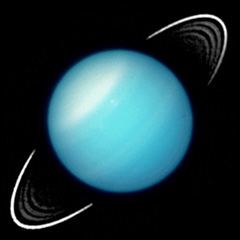
Uranus is the seventh planet from the Sun and the third largest (by diameter). Uranus is larger in diameter but smaller in mass than Neptune.

Orbit: 2,870,990,000 km (19.218 AU) from Sun
Orbital period: 30799.095 days
Average orbital speed: 6.81 km/s
Diameter: 51,118 km (equatorial)
Mass: 8.683e25 kg
Equatorial surface gravity: 8.69 m/s² 0.886 g
Surface temp: mean 76 K
Sidereal rotation period: -0.71833 day (17 h 14 min 24 s)
Equatorial rotation velocity: 2.59 km/s (9320 km/h)
Uranus's axis of rotation lies on its side with respect to the plane of the Solar System, with an axial tilt of 97.77 degrees. This gives it seasonal changes completely unlike those of the other major planets. Other planets can be visualized to rotate like tilted spinning tops relative to the plane of the solar system, while Uranus rotates more like a tilted rolling ball. Near the time of Uranian solstices, one pole faces the Sun continuously while the other pole faces away.
Uranus is composed primarily of rock and various ices, with only about 15% hydrogen and a little helium (in contrast to Jupiter and Saturn which are mostly hydrogen). Uranus (and Neptune) are in many ways similar to the cores of Jupiter and Saturn minus the massive liquid metallic hydrogen envelope. It appears that Uranus does not have a rocky core like Jupiter and Saturn but rather that its material is more or less uniformly distributed.
Uranus' atmosphere is about 83% hydrogen, 15% helium and 2% methane.

Uranus has rings. Like Jupiter's, they are very dark but like Saturn's they are composed of fairly large particles ranging up to 10 meters in diameter in addition to fine dust. There are 11 known rings, all very faint; the brightest is known as the Epsilon ring. The Uranian rings were the first after Saturn's to be discovered. This was of considerable importance since we now know that rings are a common feature of planets, not a peculiarity of Saturn alone.
uranusring

Distance   Width
Ring       (km)      (km)
-------  --------   -----
1986U2R    38000    2,500
6          41840    1-3
5          42230    2-3
4          42580    2-3
Alpha      44720    7-12
Beta       45670    7-12
Eta        47190    0-2
Gamma      47630    1-4
Delta      48290    3-9
1986U1R    50020    1-2
Epsilon    51140    20-100
Uranus has 21 named moons and six unnamed ones
Distance  Radius    Mass
Satellite  (000 km)   (km)     (kg)   Discoverer   Date
---------  --------  ------  -------  ----------  -----
Cordelia         50      13    ?      Voyager 2    1986
Ophelia          54      16    ?      Voyager 2    1986
Bianca           59      22    ?      Voyager 2    1986
Cressida         62      33    ?      Voyager 2    1986
Desdemona        63      29    ?      Voyager 2    1986
Juliet           64      42    ?      Voyager 2    1986
Portia           66      55    ?      Voyager 2    1986
Rosalind         70      27    ?      Voyager 2    1986
Cupid            75       6    ?      Showalter    2003
Belinda          75      34    ?      Voyager 2    1986
Perdita          76      40    ?      Voyager 2    1986
Puck             86      77    ?      Voyager 2    1985
Mab              98       8    ?      Showalter    2003
Miranda         130     236  6.30e19  Kuiper       1948
Ariel           191     579  1.27e21  Lassell      1851
Umbriel         266     585  1.27e21  Lassell      1851
Titania         436     789  3.49e21  Herschel     1787
Oberon          583     761  3.03e21  Herschel     1787
Francisco      4281       6    ?      Sheppard     2003
Caliban        7169      40    ?      Gladman      1997
Stephano       7948      15    ?      Gladman      1999
Trinculo       8578       5    ?      Holman       2001
Sycorax       12213      80    ?      Nicholson    1997
Margaret      14689       6    ?      Sheppard     2003
Prospero      16568      20    ?      Holman       1999
Setebos       17681      20    ?      Kavelaars    1999
Ferinand      21000       6    ?      Sheppard     2003
uranusmoons
They form three distinct classes: the 11 small very dark inner ones discovered by Voyager 2, the 5 large ones (right), and the newly discovered much more distant ones. Most have nearly circular orbits in the plane of Uranus' equator (and hence at a large angle to the plane of the ecliptic); the outer 4 are much more elliptical.

NEPTUNE
neptune
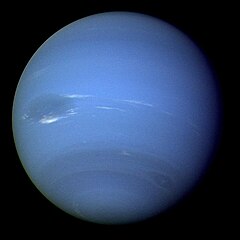
Neptune is the eighth planet from the Sun and the fourth largest (by diameter). Neptune is smaller in diameter but larger in mass than Uranus.

Orbit from Sun: 4,504,000,000 km (30.06 AU)
Orbital period: 164.79 years
Average orbital speed: 5.43 km/s
Diameter: 49,532 km (equatorial)
Mass: 1.0247e26 kg
Equatorial surface gravity: 11.15 m/s² 1.14 g
Surface temp: mean 72 K
Sidereal rotation period: 0.6713 day (16 h 6 min 36 s)
Equatorial rotation velocity: 2.68 km/h (9660 km/s)
Neptune's composition is probably similar to Uranus': various "ices" and rock with about 15% hydrogen and a little helium. Like Uranus, but unlike Jupiter and Saturn, it may not have a distinct internal layering but rather to be more or less uniform in composition. But there is most likely a small core (about the mass of the Earth) of rocky material. Its atmosphere is mostly hydrogen and helium with a small amount of methane.
Neptune's blue color is largely the result of absorption of red light by methane in the atmosphere but there is some additional as-yet-unidentified chromophore which gives the clouds their rich blue tint.
Neptune also has rings. Earth-based observations showed only faint arcs instead of complete rings, but Voyager 2's images showed them to be complete rings with bright clumps. One of the rings appears to have a curious twisted structure.
Distance   Width
Ring       (km)      (km)     aka
-------  --------   -----   -------
Diffuse    41900       15   1989N3R, Galle
Inner      53200       15   1989N2R, LeVerrier
Plateau    53200     5800   1989N4R, Lassell, Arago
Main       62930     < 50   1989N1R, Adams 
neptunering

Neptune has 13 known moons.
Distance  Radius    Mass
Satellite  (000 km)   (km)     (kg)   Discoverer   Date
---------  --------  ------  -------  ----------  -----
Naiad            48      29      ?    Voyager 2    1989
Thalassa         50      40      ?    Voyager 2    1989
Despina          53      74      ?    Voyager 2    1989
Galatea          62      79      ?    Voyager 2    1989
Larissa          74      96      ?    Voyager 2    1989
Proteus         118     209      ?    Voyager 2    1989
Triton          355    1350  2.14e22  Lassell      1846
Nereid         5509     170      ?    Kuiper       1949

Triton
Triton (radius: 355000 km, mass: 2.14e22 kg)