NEWTON'S LAW OF UNIVERSAL GRAVITATION
(Article = http://en.wikipedia.org/wiki/Newton%27s_law_of_universal_gravitation)
Newton's
law of universal gravitation states that every massive particle in the
universe attracts every other massive particle with a force which is
directly proportional to the product of their masses and inversely
proportional to the square of the distance between them. (Separately it
was shown that large spherically-symmetrical masses attract and are
attracted as if all their mass were concentrated at their centers.) This
is a general physical law derived from empirical observations by what
Newton called induction.

Every
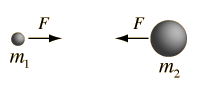
point mass attracts every single other point mass by a force pointing
along the line intersecting both points. The force is directly
proportional to the product of the two masses and inversely proportional
to the square of the distance between the point masses.

where:
* F is the magnitude of the gravitational force between the two point masses,
* G is the gravitational constant,
* m1 is the mass of the first point mass,
* m2 is the mass of the second point mass, and
* r is the distance between the two point masses.
Assuming SI units, F is measured in newtons (N), m1 and m2 in kilograms (kg), r in meters (m), and the
constant G is approximately equal to 6.674×10⁻¹¹ N m2 kg−2.
The value of the constant G was first accurately determined from the
results of the Cavendish experiment conducted by the British scientist
Henry Cavendish in 1798, although Cavendish did not himself calculate a
numerical value for G. This experiment was also the first test of
Newton's theory of gravitation between masses in the laboratory. It took
place
111 years after the publication of Newton's
Principia and 71 years after Newton's death, so none of Newton's calculations could use the value of
G; instead he could only calculate a force relative to another force.
Vector form
Newton's
law of universal gravitation can be written as a vector equation to
account for the direction of the gravitational force as well as its
magnitude. In this formula, quantities in bold represent vectors.

where
- F12 is the force applied on object 2 due to object 1,
- G is the gravitational constant,
- m1 and m2 are respectively the masses of objects 1 and 2,
- |r12| = |r2 − r1| is the distance between objects 1 and 2, and
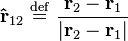 is the unit vector from object 1 to 2.
It
can be seen that the vector form of the equation is the same as the
scalar form given earlier, except that F is now a vector quantity, and
the right hand side is multiplied by the appropriate unit vector. Also,
it can be seen that F12 = −F21.
Gravitational field
The
gravitational field is a vector field that describes the gravitational
force which would be applied on an object in any given point in space,
per unit mass. It is actually equal to the gravitational acceleration at
that point.


It
is a generalization of the vector form, which becomes particularly
useful if more than 2 objects are involved (such as a rocket between the
Earth and the Moon). For 2 objects (e.g. object 2 is a rocket, object 1
the Earth), we simply write r instead of r12 and m instead of m2 and
define the gravitational field g(r) as:

so that we can write:

This formulation is dependent on the objects causing the field. The field has units of acceleration; in SI, this is m/s2.
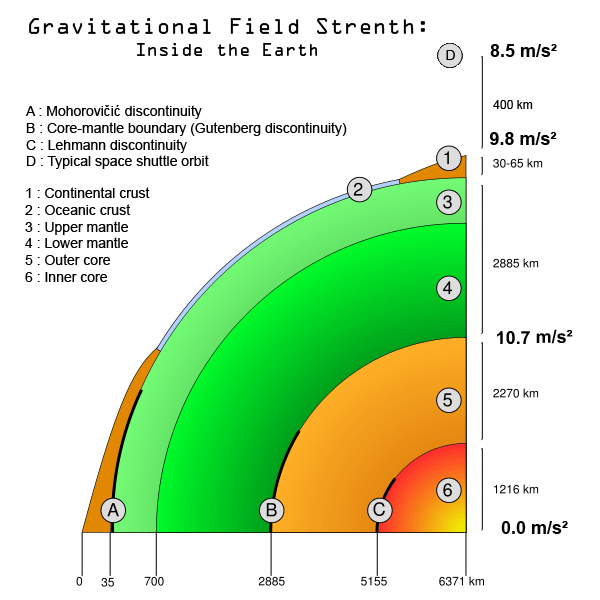
Gravitational acceleration
In physics, gravitational acceleration is the specific force or
acceleration on an object caused by gravity. In a vacuum, all small
bodies accelerate in a gravitational field at the same rate relative to
the center of mass. This is true regardless of the mass or composition
of the body. On the surface of the Earth, all objects fall with an
acceleration between 9.78 and 9.82 m/s2 depending on latitude, with a
conventional standard value of exactly 9.80665 m/s2 (approx. 32.174
ft/s2). Objects with low densities do not accelerate as rapidly due to
buoyancy and air resistance. In a vacuum all small objects have same
acceleration regardless of density.
The barycentric gravitational acceleration at a point in space is given by:

where:
M is the mass of the attracting object,

is the unit vector from center of mass of the attracting object to the center of mass of the object being accelerated.
r is the distance between the two objects.
G is the gravitational constant of the universe.
The relative acceleration of two the objects in the reference frame of the attracting object is:

The relative acceleration depends on both masses.
Disregarding
air resistance and the Earth's movement towards falling objects, all
masses (large or small) dropped simultaneously will hit the ground at
the same time. All masses lifted one at a time and dropped will hit the
ground at the same time.
In General Relativity
In
Einstein's theory of general relativity, gravitation is an attribute of
curved spacetime instead of being due to a force propagated between
bodies. In Einstein's theory, masses distort spacetime in their
vicinity, and other particles move in trajectories determined by the
geometry of spacetime. The gravitational force is a fictitious force;
the gravitational acceleration of a body in free fall is due to its
world line being a geodesic of spacetime.


 Consider
the flying motion of birds. A bird flies by use of its wings. The wings
of a bird push air downwards. Since forces result from mutual
interactions, the air must also be pushing the bird upwards. The size of
the force on the air equals the size of the force on the bird; the
direction of the force on the air (downwards) is opposite the direction
of the force on the bird (upwards). For every action, there is an equal
(in size) and opposite (in direction) reaction. Action-reaction force
pairs make it possible for birds to fly.
Consider
the flying motion of birds. A bird flies by use of its wings. The wings
of a bird push air downwards. Since forces result from mutual
interactions, the air must also be pushing the bird upwards. The size of
the force on the air equals the size of the force on the bird; the
direction of the force on the air (downwards) is opposite the direction
of the force on the bird (upwards). For every action, there is an equal
(in size) and opposite (in direction) reaction. Action-reaction force
pairs make it possible for birds to fly.


